"Perhaps paperback publishing's most bizarre instance of self-censorship occurred in Great Britain. Allen Lane, Penguin founder, was 'particularly affronted' by a book his company published. With a friend he staged a midnight raid on his own warehouse. After breaking in, he loaded the offending books on a truck and carried them to his farm some miles away, where they were immediately burned."
- Thomas Bonn, UnderCover : An Illustrated History of American Mass Paperbacks, N. Y., Penguin, 1982, p. 55.
Tuesday, June 14, 2011

Monday, June 13, 2011
Site of the Month
Familien Olsens web-sted
This is a fun site which features a Danish family’s various collectible stuff. My favorites include the pages on Danish hardboiled imprints from vintage era, and the collection of hot Carter Brown covers. Another plus is the exceptional quality of the cover scans. About the only criticism is that the organization is a bit of a mystery to me. Site map is here.


This is a fun site which features a Danish family’s various collectible stuff. My favorites include the pages on Danish hardboiled imprints from vintage era, and the collection of hot Carter Brown covers. Another plus is the exceptional quality of the cover scans. About the only criticism is that the organization is a bit of a mystery to me. Site map is here.


Friday, June 3, 2011
Dell S11 (1961)
Title : My Wicked, Wicked Ways
Author : Errol Flynn
Cover artist : photograph
[N. Y. : Dell, 1961. No. S11. Cover photo of Errol Flynn. "First Dell printing, January 1961."]
"The bare facts just as Flynn himself dared to reveal them. This and only this book includes them all."
style ****
substance ****
collectibility **

The [uncredited] cover photo for Dell S-11 complements the book’s sensational contents : brandishing a cigarette holder and wearing a smoking jacket, Flynn is rendered in most impish, rascally fashion. But the picture also hints at other qualities we don’t usually associate with Errol Flynn -- grace, dignity and sophistication, qualities which, by the way, appear in My Wicked, Wicked Ways.
Which brings us to the fact that - for better or worse - more books have been written about Errol Flynn than any other film actor. Biographers have not always been kind, however. Flynn’s second wife Nora Eddington was, perhaps appropriately, first out of the gate with her warts and all memoir Errol and Me, which appeared a year after the actor’s death. In the following decades authors cranked out Flynn biographies which progressively upped the ante in character assassination and scandal recollection [1]. But it may be that the wily Flynn had outflanked his critics all along, in the process getting in the last word preemptively [2]. Flynn wisely got his peccadillos out in the open in Wicked Ways, and all the trashy tomes which followed merely expanded or enlivened what was already known more than half a century ago. And no, he was not, after all, a sadist, closet gay, or Nazi spy, but all the other stuff was pretty much true, having been confirmed early on by Flynn’s own pen.
At any rate, there have been many movie star biographies [3], but Flynn’s is my choice as the best [4] : he was a born raconteur; had great subject matter to work with [his own life story]; and wrote very well.
I leave the last word to Irene Palfy at All That Glistens Could be Old, because it sums up my thoughts so well:
" . . . I enjoy that much that I'd like to read it forever. So I just read a bit and put it away - and then read again a little bit later."
[1] There’s a certain belated justice in the generally good press which Flynn enjoys today, which eluded him during his lifetime and the first four decades or so after his death.
[2] Flynn might have beaten his critics to the punch in another way, albeit in a different context. Much has been made of Wicked Ways' playing fast and loose with the truth -- certain facts are incorrect and some recollections have been exaggerated, fabricated or otherwise 'improved.' However, perhaps an equally compelling case can be made for the book's emotional truth, in that it gives us an insight into the inner nature of the man. Flynn was not exactly the first celebrity to write a somewhat fictionalized autobiography, but one could say that he mastered and crystallized the genre, much in the same way that Truman Capote, with In Cold Blood, perfected the ‘nonfiction novel’ without actually inventing the form.
[3] There's also been much commentary on Wicked Ways’ ghostwritten status, and it’s true that author Earl Conrad spent three months in Jamaica in 1958-59, assisting Flynn on the book. However, sources are vague as to Conrad’s actual role in the mechanics of writing Wicked Ways. Flynn was a great storyteller, and his writing credentials were well-established by this time, with a couple of books and numerous articles and journalistic dispatches to his credit, along with various half-completed projects. Moreover, the book has a quintessentially and uniquely Flynnian voice and attitude. It may well be that Conrad’s contribution to Wicked Ways is much less than traditionally credited, and that his role consisted mostly of more prosaic, if eminently necessary, tasks like keeping the project on track and thus assuring its completion. Flynn hinted as much when he insisted that only his name be listed as the author. In any case it seems that the ghosted meme over-rates Conrad’s role in the book and shows far too little appreciation of Flynn’s genuine literary skills.
[4] Even the best biographies like Thomas McNulty’s Errol Flynn : the Life and Career and Peter Valenti’s Errol Flynn : a Bio-Bibliography seem flat and colorless when compared to the original.
Reviews : Piddleville; Via Margutta 51; MissRosen. See also : Scott Eyman, Tragic, Tempestuous Life of Palm Beach’s Forgotten Star, Lili Damita, Palm Beach Post, April 8, 2011.
Which brings us to the fact that - for better or worse - more books have been written about Errol Flynn than any other film actor. Biographers have not always been kind, however. Flynn’s second wife Nora Eddington was, perhaps appropriately, first out of the gate with her warts and all memoir Errol and Me, which appeared a year after the actor’s death. In the following decades authors cranked out Flynn biographies which progressively upped the ante in character assassination and scandal recollection [1]. But it may be that the wily Flynn had outflanked his critics all along, in the process getting in the last word preemptively [2]. Flynn wisely got his peccadillos out in the open in Wicked Ways, and all the trashy tomes which followed merely expanded or enlivened what was already known more than half a century ago. And no, he was not, after all, a sadist, closet gay, or Nazi spy, but all the other stuff was pretty much true, having been confirmed early on by Flynn’s own pen.
At any rate, there have been many movie star biographies [3], but Flynn’s is my choice as the best [4] : he was a born raconteur; had great subject matter to work with [his own life story]; and wrote very well.
I leave the last word to Irene Palfy at All That Glistens Could be Old, because it sums up my thoughts so well:
" . . . I enjoy that much that I'd like to read it forever. So I just read a bit and put it away - and then read again a little bit later."
[1] There’s a certain belated justice in the generally good press which Flynn enjoys today, which eluded him during his lifetime and the first four decades or so after his death.
[2] Flynn might have beaten his critics to the punch in another way, albeit in a different context. Much has been made of Wicked Ways' playing fast and loose with the truth -- certain facts are incorrect and some recollections have been exaggerated, fabricated or otherwise 'improved.' However, perhaps an equally compelling case can be made for the book's emotional truth, in that it gives us an insight into the inner nature of the man. Flynn was not exactly the first celebrity to write a somewhat fictionalized autobiography, but one could say that he mastered and crystallized the genre, much in the same way that Truman Capote, with In Cold Blood, perfected the ‘nonfiction novel’ without actually inventing the form.
[3] There's also been much commentary on Wicked Ways’ ghostwritten status, and it’s true that author Earl Conrad spent three months in Jamaica in 1958-59, assisting Flynn on the book. However, sources are vague as to Conrad’s actual role in the mechanics of writing Wicked Ways. Flynn was a great storyteller, and his writing credentials were well-established by this time, with a couple of books and numerous articles and journalistic dispatches to his credit, along with various half-completed projects. Moreover, the book has a quintessentially and uniquely Flynnian voice and attitude. It may well be that Conrad’s contribution to Wicked Ways is much less than traditionally credited, and that his role consisted mostly of more prosaic, if eminently necessary, tasks like keeping the project on track and thus assuring its completion. Flynn hinted as much when he insisted that only his name be listed as the author. In any case it seems that the ghosted meme over-rates Conrad’s role in the book and shows far too little appreciation of Flynn’s genuine literary skills.
[4] Even the best biographies like Thomas McNulty’s Errol Flynn : the Life and Career and Peter Valenti’s Errol Flynn : a Bio-Bibliography seem flat and colorless when compared to the original.
Reviews : Piddleville; Via Margutta 51; MissRosen. See also : Scott Eyman, Tragic, Tempestuous Life of Palm Beach’s Forgotten Star, Lili Damita, Palm Beach Post, April 8, 2011.
Wednesday, June 1, 2011
Hue and Cry (Jefferson House, 1944)
Title : Hue and Cry
Author : Thomas B. Dewey
Cover art : uncredited
[N. Y. : Jefferson House, 1944 Released in the UK as The Murder of Marion Mason].
style ***
substance **
collectibility ***

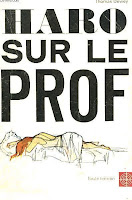
One of the more unjustly neglected of mid-twentieth century mystery writers, Thomas B. Dewey is perhaps best known for two series private eyes, Pete Schofield and ‘Mac’. Another series character was the less well known Singer Batts, who appeared in four novels. Batts owns a hotel in ‘Preston, Ohio’ and is also a bibliophile and Shakespeare expert. He made his first appearance in Hue and Cry, coincidentally also Dewey’s first book. Alas there never seems to have been a paperback release (in the U.S.). Note the 1963 French take, which is no.10 of the ‘Haute Tension’ series. The unattributed cover for the Jefferson House first printing has a quirky charm with its vaguely surrealistic/cubist, mildly risqué rendering of an [almost topless] woman. The use of chalky greys for woman’s flesh is actually kind of refreshing; also nice off-yellow lettering.
Author : Thomas B. Dewey
Cover art : uncredited
[N. Y. : Jefferson House, 1944 Released in the UK as The Murder of Marion Mason].
style ***
substance **
collectibility ***

One of the more unjustly neglected of mid-twentieth century mystery writers, Thomas B. Dewey is perhaps best known for two series private eyes, Pete Schofield and ‘Mac’. Another series character was the less well known Singer Batts, who appeared in four novels. Batts owns a hotel in ‘Preston, Ohio’ and is also a bibliophile and Shakespeare expert. He made his first appearance in Hue and Cry, coincidentally also Dewey’s first book. Alas there never seems to have been a paperback release (in the U.S.). Note the 1963 French take, which is no.10 of the ‘Haute Tension’ series. The unattributed cover for the Jefferson House first printing has a quirky charm with its vaguely surrealistic/cubist, mildly risqué rendering of an [almost topless] woman. The use of chalky greys for woman’s flesh is actually kind of refreshing; also nice off-yellow lettering.

Wednesday, May 18, 2011
Signet 1755 (1960)
Title : Cobra Venom
Author : John B. West
Cover art : Jerry Allison
[New York, Signet, 1960. No. 1755].
Author : John B. West
Cover art : Jerry Allison
[New York, Signet, 1960. No. 1755].
style ***
substance **
collectibility *
substance **
collectibility *

John B. West's Rocky Steele was a lively entry into the crowded field of private eye fiction in the late 1950s. According to one source, Steele was a P.I. so tough he made Mike Hammer look like Liberace [1]. But what was probably most interesting about this series was that author John B. West was a black physician practising in West Africa [2], as well as a part-time owner of a broadcasting company, manufacturing firm, and a hotel/restaurant chain, when he wrote the Steele thrillers. A good summary of the Rocky Steele aesthetic can be found here and here.

Fittingly, the John B. West novels were rather well served by vintage cover art; even the mid sixties reissues, while lacking perhaps the naive, visceral charm of the Signet originals, nonetheless have a beguiling elegance of their own.
For the featured title of Signet 1755, Jerry Allison's incredibly intense cover art nicely captures the grittiness of the character in dramatically chiarscuro-esque fashion. But for sheer over-the-top visuals nothing can compare to the usually restrained Barye Phllips' ultra-exploitative take for Taste for Blood.
[1] Max Allan Collins, History of Mystery, p. 148.
[2] Liberia, to be exact.


Wednesday, May 11, 2011
Dell D298 (1959)
Title : Murder on Broadway (aka The Last Gamble)
Author : Hal Masur
Cover art : Victor Kalin
[New York, Dell, 1959. No. D298. Front cover : Victor Kalin. 'First Dell printing, July 1959.' First published in hardcover, Simon & Schuster, 1958, as The Last Gamble. Published in the UK as The Last Breath. Variant issue : back cover, advertisement for Paris Belts.]
Author : Hal Masur
Cover art : Victor Kalin
[New York, Dell, 1959. No. D298. Front cover : Victor Kalin. 'First Dell printing, July 1959.' First published in hardcover, Simon & Schuster, 1958, as The Last Gamble. Published in the UK as The Last Breath. Variant issue : back cover, advertisement for Paris Belts.]
style ***
substance **
collectibility *
substance **
collectibility *

Victor Kalin worked in a variety of venues but his vintage pb cover art is among the finest from the classic era. Kalin’s sensitive portraiture of beautiful women had a exceptionally luminous quality ..... indeed the the brightly lit, almost radioactive quality of the women suggest that they are about to burst into flames at any minute. This is in contrast to, say, the cover art of Robert McGinnis, who portrayed women in a cooler, more objective style. It also contrasts with Rudolph Belarski’s somewhat hokier glowing women effects for Popular Library in the early 1950s. The Belarski covers are of course classic examples of vintage cover art at its lurid best but somehow I prefer the leaner, more stylish Kalin look. I’m not enough of an expert on art technique to know what methods are used to get the effects but who cares when the results are this good.


In any case, while Murder on Broadway is a more subdued entry in the Kalin canon, it nonetheless is one of his stronger efforts; great touches abound : the girl’s subtle reflection in the mirror, the quasi-sfumato shadings. It all combines to create a minor masterpiece. We only have to compare to the covers of the later printings, released as The Last Gamble, to know that the Kalin magic is missing in these versions. More on Kalin’s cover art can be found here and here.
 |
| Dell D250 |
 |
Dell 886 |
Saturday, May 7, 2011
Dell 346 (1953)
Title : No Mourners Present
Author : Frank Presnell
Cover art : Robert Stanley
[New York, Dell, 1953. Mapback. No. 346.]
style **
substance **
collectibility *

Continuing with the fire/explosions subgenre is Robert Stanley’s fetching cover art for Dell 346, which despite a certain cartoonish, mannequin-like quality to the figures, packs a punch with the fire-draped upturned auto in the background. Overall, this one doesn’t quite have the panache of the previously cited Nightmare at Noon but it’s a strong late entry in the Dell canon nonetheless.
Author : Frank Presnell
Cover art : Robert Stanley
[New York, Dell, 1953. Mapback. No. 346.]
style **
substance **
collectibility *

Continuing with the fire/explosions subgenre is Robert Stanley’s fetching cover art for Dell 346, which despite a certain cartoonish, mannequin-like quality to the figures, packs a punch with the fire-draped upturned auto in the background. Overall, this one doesn’t quite have the panache of the previously cited Nightmare at Noon but it’s a strong late entry in the Dell canon nonetheless.
 |
| Morrow, 1942 |
Subscribe to:
Posts (Atom)